

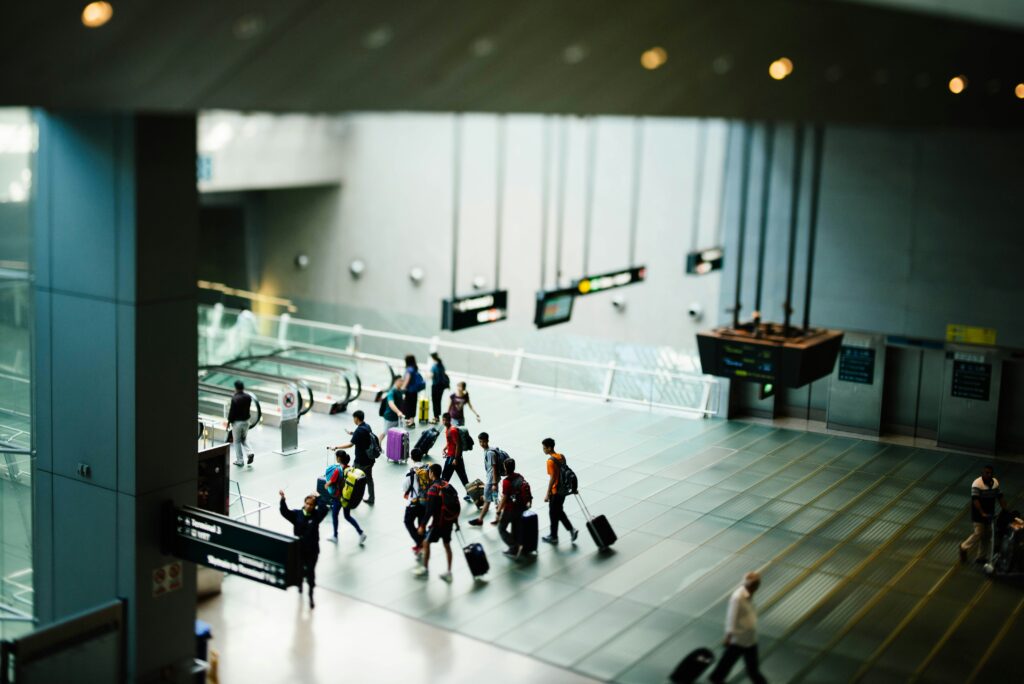
Every major airport faces the same problem during peak tourist seasons.
Passenger volume spikes, queues stretch across terminals, and security teams are pushed to their limits. A single delay at security screening or immigration can ripple across the entire airport, leading to missed flights, frustrated travelers, and operational chaos.
The scale of the challenge is massive.
In 2024 alone, global air travel crossed 8 billion passengers, and airports like Dubai, Atlanta, and Heathrow regularly handle 200,000 to 300,000 passengers per day during peak periods. During holiday seasons, some terminals operate at 120% of their designed capacity, which significantly increases pressure on security operations.
And here’s the real issue.
Airports are not just dealing with more people. They are dealing with unpredictable movement patterns, security risks, and strict compliance requirements all at the same time. Traditional CCTV systems can record everything, but they cannot help teams respond faster or make decisions in real time.
That is why modern airport security solutions are shifting toward AI-driven systems.
Instead of passively monitoring footage, AI helps airports understand what is happening, detect risks instantly, and manage high tourist traffic without slowing down operations.
Let’s break down how this actually works in real-world airport environments.
1. Managing Passenger Congestion Before It Becomes a Problem
One of the biggest operational risks in airports is not security breaches. It is crowd congestion.
During peak hours, queues at check-in counters, baggage drops, and security checkpoints can quickly spiral out of control. When congestion builds up, it does not just slow down passengers. It creates safety risks, increases stress levels, and puts pressure on airport staff.
AI-powered systems solve this by continuously analyzing crowd density and movement patterns across terminals.
Instead of relying on manual observation, airport teams get real-time visibility into where congestion is forming and how it is evolving.
This allows them to:
- Monitor queue lengths at security checkpoints
- Detect overcrowding in waiting areas and boarding zones
- Identify unusual crowd movement patterns
- Trigger alerts when density exceeds safe thresholds
For example, if a security lane suddenly becomes overloaded, the system can flag it immediately. Staff can then open additional lanes or redirect passengers before delays escalate.
This proactive approach is what separates modern airport operations from traditional ones.
2. Real-Time Threat Detection in High-Traffic Environments
Airports are high-risk environments where even small security lapses can have serious consequences.
The challenge becomes harder when thousands of people are moving through the same space. Human monitoring alone is not enough to track everything effectively.
AI changes this by continuously analyzing video feeds and identifying potential risks in real time.
This includes detecting:
- Unattended baggage in public areas
- Unauthorized access to restricted zones
- Suspicious loitering near sensitive locations
- Unusual movement patterns that deviate from normal behavior
What makes AI effective is its ability to understand context.
For example, a passenger standing near a gate is normal. But someone staying in the same spot near a restricted entry point for an extended period may require attention. AI systems can identify these subtle differences and alert security teams instantly.
Modern platforms like Coram’s airport security solutions are built to handle these challenges at scale. They work with existing IP cameras and provide real-time monitoring, intelligent alerts, and centralized visibility across terminals. This allows airport security teams to detect and respond to threats faster without manually reviewing hours of footage.
In high-traffic environments, this speed is critical.
3. Faster Incident Response Across Large Airport Facilities
Airports are massive environments with multiple terminals, entry points, and operational zones.
When an incident occurs, the biggest challenge is not just detection. It is coordination.
Security teams need to understand:
- Where the incident is happening
- How many people are involved
- Which areas are affected
- How to respond without disrupting operations
AI-powered systems provide this clarity.
By integrating surveillance with real-time alerts and centralized dashboards, they allow teams to respond faster and more effectively.
For example, if a security issue is detected in one terminal, teams in other areas can be notified instantly. This improves coordination and ensures that response efforts are aligned.
Instead of reacting in isolation, teams operate with shared visibility.
4. Improving Passenger Experience Without Compromising Security
Security and passenger experience often feel like trade-offs.
Stricter security can slow down processes, while faster movement can increase risk. AI helps balance both.
By optimizing passenger flow and reducing unnecessary delays, AI-powered systems improve the overall travel experience.
Airports can:
- Reduce waiting times at checkpoints
- Improve queue management
- Minimize congestion in high-traffic zones
- Ensure smoother boarding processes
This has a direct impact on passenger satisfaction.
Studies show that long wait times are one of the biggest factors affecting traveler experience. Even a 10–15 minute reduction in queue time can significantly improve satisfaction scores.
AI enables this without compromising safety.
5. Enhancing Access Control in Restricted Zones
Airports have multiple restricted areas that require strict access control.
These include:
- Baggage handling zones
- Runways and maintenance areas
- Security control rooms
- Staff-only operational spaces
Managing access to these areas becomes more complex as traffic increases.
AI enhances access control by adding a layer of intelligence.
Instead of simply allowing or denying entry, systems can monitor behavior around access points and detect unusual activity.
This helps:
- Prevent unauthorized entry
- Detect tailgating incidents
- Monitor after-hours access
- Verify activity visually
By combining access control with video analytics, airports gain better visibility and stronger security.
6. Turning Security Data into Operational Insights
One of the most valuable aspects of AI is its ability to generate insights from data.
Every movement, entry, and interaction within an airport creates data. When analyzed correctly, this data can improve both security and operations.
Airports can use AI to:
- Identify peak traffic hours
- Understand passenger flow patterns
- Detect recurring bottlenecks
- Optimize staffing and resource allocation
For example, if certain checkpoints consistently experience congestion at specific times, staffing levels can be adjusted accordingly.
This turns security systems into decision-making tools.
Instead of reacting to problems, airports can prevent them.
7. Scaling Security Without Increasing Complexity
As passenger numbers grow, airports need to scale their security systems.
Traditional systems struggle with this because they require more hardware, more monitoring, and more manual effort.
AI-powered systems scale more efficiently.
They can:
- Handle large volumes of data
- Monitor multiple locations simultaneously
- Provide centralized control across terminals
- Reduce reliance on manual monitoring
This allows airports to expand operations without significantly increasing complexity.
In a world where air travel continues to grow, this scalability is essential.
FAQs
What are airport security solutions?
They are integrated systems that combine surveillance, access control, and analytics to monitor and secure airport operations.
How does AI improve airport security?
AI analyzes video in real time, detects unusual behavior, and sends alerts, allowing faster response and better decision-making.
Can AI reduce airport congestion?
Yes. AI helps monitor crowd density and optimize passenger flow, reducing delays and improving efficiency.
Does AI replace human security teams?
No. It enhances their effectiveness by automating monitoring and highlighting critical events.
Are AI security systems scalable?
Yes. They are designed to handle large volumes of data and support multi-terminal operations.
Conclusion
Airports are becoming more complex, more crowded, and more demanding. Traditional security systems are no longer enough to manage this environment effectively.
AI-powered airport security solutions provide the intelligence, speed, and scalability needed to handle high tourist traffic without compromising safety.
They help detect risks faster, manage crowds more efficiently, and improve overall operations.
And as passenger numbers continue to grow, this shift is not optional.
 Meiwasara Klein is the kind of writer who genuinely cannot publish something without checking it twice. Maybe three times. They came to essential travel tips and tricks through years of hands-on work rather than theory, which means the things they writes about — Essential Travel Tips and Tricks, Global Destination Guides, Hidden Gems, among other areas — are things they has actually tested, questioned, and revised opinions on more than once.
That shows in the work. Meiwasara's pieces tend to go a level deeper than most. Not in a way that becomes unreadable, but in a way that makes you realize you'd been missing something important. They has a habit of finding the detail that everybody else glosses over and making it the center of the story — which sounds simple, but takes a rare combination of curiosity and patience to pull off consistently. The writing never feels rushed. It feels like someone who sat with the subject long enough to actually understand it.
Outside of specific topics, what Meiwasara cares about most is whether the reader walks away with something useful. Not impressed. Not entertained. Useful. That's a harder bar to clear than it sounds, and they clears it more often than not — which is why readers tend to remember Meiwasara's articles long after they've forgotten the headline.
Meiwasara Klein is the kind of writer who genuinely cannot publish something without checking it twice. Maybe three times. They came to essential travel tips and tricks through years of hands-on work rather than theory, which means the things they writes about — Essential Travel Tips and Tricks, Global Destination Guides, Hidden Gems, among other areas — are things they has actually tested, questioned, and revised opinions on more than once.
That shows in the work. Meiwasara's pieces tend to go a level deeper than most. Not in a way that becomes unreadable, but in a way that makes you realize you'd been missing something important. They has a habit of finding the detail that everybody else glosses over and making it the center of the story — which sounds simple, but takes a rare combination of curiosity and patience to pull off consistently. The writing never feels rushed. It feels like someone who sat with the subject long enough to actually understand it.
Outside of specific topics, what Meiwasara cares about most is whether the reader walks away with something useful. Not impressed. Not entertained. Useful. That's a harder bar to clear than it sounds, and they clears it more often than not — which is why readers tend to remember Meiwasara's articles long after they've forgotten the headline.